
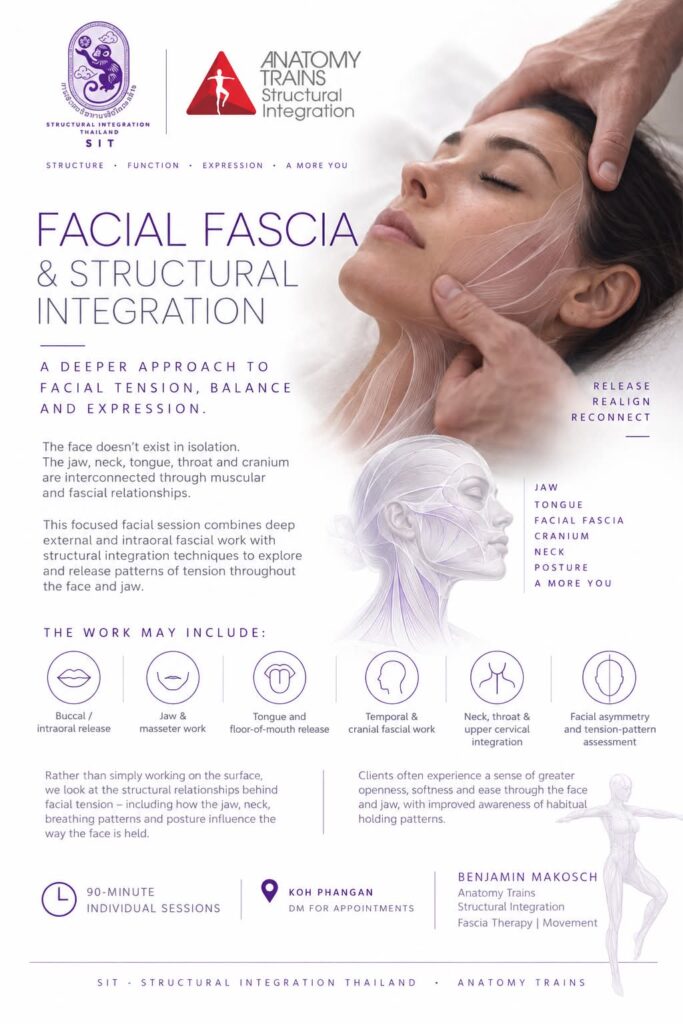
Facial Fascia Therapy: Structural Integration
BookDiscovered on Todo.Today, for more events in Koh Phangan
The face is the most expressive part of the body and the most habitually held. Years of squinting, jaw clenching, and swallowed tension settle into the thin fascial layers around the jaw, temples, eyes, and scalp. These layers don't stay local. The fascia of the face is continuous with the neck, throat, and the whole front line of the body, so the way you hold your face is part of how you hold your posture.
In this session we work slowly and precisely: masseter and temporalis, the tissue around the jaw hinge, the fascia over the cheekbones and around the orbits, the scalp, and the base of the skull. Intra-oral work where appropriate and agreed.
What people usually notice afterwards: the jaw opens more freely, the eyes feel wider, tension headaches ease, the breath drops deeper, and the whole face settles.
Read fascia. Feel fascia. Work fascia.